
Ode to natural fibres
Canework and wickerwork
Whether we’re talking about rattan, derived from rotang, a plant of the liana family of palms, or wicker, a type of willow with flexible branches, plant fibres are prized for their flexibility and resistance. The history of working with these materials – the crafts of canework and wickerwork – dates back centuries yet they retain their modernity. With the new Havana dining set and the the flower basket, Tectona once again place artisanal craftsmanship at the service of durable creations.

Rattan, a material as ecological as inspiring, with a long history
The oldest evidence of humans working with rattan is found in Asia. As a woody plant, rattan is highly resistant yet flexible, qualities that have allowed the material to flourish under human ingenuity. During the Second Empire period in France (1852–70), aristocrats enthusiastically adopted this material to furnish their winter lounges — areas for enjoying daylight while sheltered. Around the same time, woven chairs started appearing in Parisian cafes, helping to forge the popular and now classic image of the French art de vivre.
Subsequently rattan made its entry inside properties, particularly second homes, with rattan representing a notion of escape. Throughout the 20th century, many leading designers explored its possibilities and some of their creations would become iconic: Louis Sognot, Mathieu Matégot, Joseph-André Motte – and notably Janine Abraham and Dirk Jan Rol, who were awarded a Gold Medal at the Brussel’s World Fair in 1958 for their Soleil armchair.
With such an illustrious creative heritage and at a time when sustainable development is a key part of caring for the environment, rattan remains very relevant.

Canework: the art of weaving rattan
A key part of canework’s appeal is its “return to nature” aesthetic, representing a quest for authenticity and simplicity. Nevertheless the material requires painstaking craftsmanship and this has been handed down over generations. Canework, visible as the openwork surfaces on the backrest and seat of armchairs, consists of weaving motifs from a “ribbon” derived from rattan canes. Weaving is done thread by thread according to a precise method: the vertical threads are stretched over the structure, then the horizontal threads, followed by diagonal intertwining that generally forms the classic star motif, although other geometric forms such as diamonds and chevrons are possible too. When weaving is completed, a wooden fishplate is placed on top to cover the holes and maintain the ensemble in place. The result is a surface that is light, resistant and comfortable – qualities that explain why canework has been used in traditional furniture for centuries. In Europe, canework has been used since since the 17th century; it became established in France in the 18th century under the Regency and Louis XV. Over the centuries canework became a decorative element in its own right, notably appearing on the backrests of armchairs where it visually lightens solid teak furniture. Beyond its aesthetic appeal, canework continues to symbolise mastery of an ancestral craft, combining utility and beauty.
Havana evokes the ambiance of winter lounges in the Second Empire while in the popular imagination it is bound up with impressionist art and cinematic images, above all the famous armchair of the film Emmanuelle.

Tectona's tribute to ratan
Tectona were drawn to rattan as it provided many possibilities for reinterpreting a traditional material. The fruit of their endeavours is the new Havana dining set, inspired by 1890s rattan furniture by the renowned company Perret & Vibert. Their winter lounge pieces in particular became spectacular examples of ingenuity and style: the canework liberates the surfaces while lines take on a new lightness encouraged by the Belle Epoque style. Havana furniture is a judicious blend of the traditional and the modern, with a touch of end-of- century exoticism.
The Havana armchair gives off an impression of lightness, while also providing optimal comfort. The table also showcases the natural material: a tabletop, with a woven surface and gently undulating sides, rests on sober leg assembly. While the set is easy to carry outdoors when the weather permits, it has been designed for interior use to protect the delicate material, which is sensitive to humidity and direct heat.

Wickerwork: build your own bouquet
Tectona also celebrates another technique using woven fibre: wickerwork, which is defined as the art of weaving or intertwining flexible natural materials to make useful or decorative objects. The object here is a flower basket, used since time immemorial, in woven wicker and available in two colours (black or natural). Use the basket to gather flowers in your garden or along country paths without damaging them. When the bouquet is placed in a vase, the basket remains a refined, decorative object.
Related products
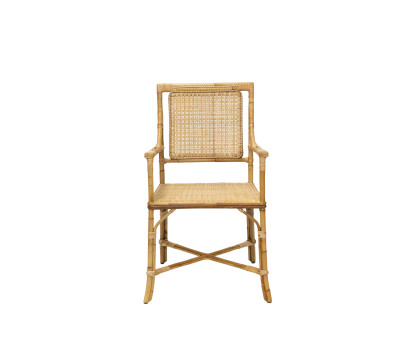
Rattan armchair
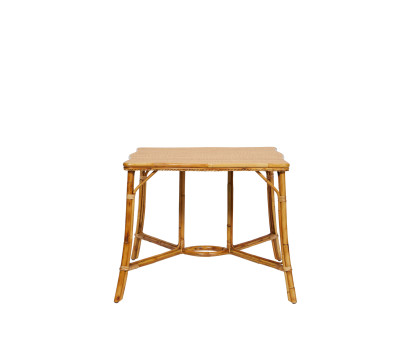
Rattan table

Rattan flower basket

